
As part of a research module that NWQ and I are currently taking, a new blog has been created to document our observations. Have a look!
Black Dillenia (http://blackdillenia.wordpress.com)
Showing posts with label Misc. Show all posts
Showing posts with label Misc. Show all posts
Saturday, January 23, 2010


Tuesday, March 10, 2009
Reality Check.
I feel heartened every time I read or hear about people doing their bit for nature. It's great that ordinary folk spend time educating the public and channelling their energies into conservation work. Then there are those who don't care and these people really get my goat.
After Pedal Ubin, we were in high spirits as we headed toward the jetty to take a bumboat back to the mainland. As it was low tide, the mudflats were exposed and we spent some time looking down for signs of life from our position on the walkway. Walking slightly ahead, I suddenly stopped short at the sight of people crouching down on the mudflats. Okay, no reason to get alarmed yet. When I got closer, the sight that lay before my eyes (and for anyone who bothered to look) confirmed my earlier suspicion.
A group of five (a mix of both males and females), with at least one wielding a long stick and a plastic bag, were nonchalantly trampling on the mudflats and destroying the burrows made by the crabs. Destroying the mudflats by trampling? Hardly. With their long stick, they proceeded to insert the end into burrow after burrow. As they pulled the stick back up each time, a lot of mud was dislodged intentionally. Disgruntled that no crabs were getting caught, they repeated the process again. One of them even took out his camera to take his friends in action.
The above happened in a matter of seconds, and by that time, the others (some guides and participants who were heading back to Changi Village) had gathered and they started calling verbal deterrents to the group below. Mindy and I informed the NParks guy at the information kiosk, who grudgingly roused himself from his nap to entertain us. As we told him what we saw, he pointed to the map of Pulau Ubin laid out and said that only Chek Jawa is a restricted zone..here we (meaning NParks) have no power..can only stop them if they're damaging or killing things (I specifically remember him giving seahorses as an example). In short, he made it sound as if people are free to do what they like in the areas that are not protected.
Clearly those people were causing damage!
We finally got him to follow us after some time (didn't seem willing to leave his post), but by then, we only saw the backs of the intrepid hunters who had finally decided to leave.
Okay, so NParks has no power to stop people from damaging areas that are not protected. Seems reasonable enough, for not ALL areas can be protected. What if endangered animals happen to live on shores/in areas that have no protection? Can poachers poach all they want?
Where do we draw the line?
The NParks staff have the option of telling people to cease their detrimental activities, but otherwise, nothing else can be done. I just called the NParks management office to ask for their take on this matter. Much of what was told to me I already heard from his fellow colleague, except that he put it across in a much nicer way. Something new to me was that the area in question falls under the jurisdiction of the LTA and even HSBC.
I asked the guy what NParks is doing about areas with no protection. His answer was that they are trying to get something done but there are politics involved. Not that word again, please.
What can we do to help?
The matter with red-tape aside, I can see why education is imperative in spreading the message of conservation. Ignorance can be attributed to the harm humans inflict and this can be reduced through education. Don't wait around for authorities to implement some policy or kick off some campaign to 'save the Earth'. It can start on the individual level, if you let it.
Did you ever collect sea shells when you were a kid? For many people, myself included, I thought that it was a harmless activity. On the day that I found out shell collection had negative effects (depriving hermit crabs of their homes, etc), I opened my mouth to start a reply but closed it when I realised that all I had to say started with either "I didn't know" or "I didn't think".
After Pedal Ubin, we were in high spirits as we headed toward the jetty to take a bumboat back to the mainland. As it was low tide, the mudflats were exposed and we spent some time looking down for signs of life from our position on the walkway. Walking slightly ahead, I suddenly stopped short at the sight of people crouching down on the mudflats. Okay, no reason to get alarmed yet. When I got closer, the sight that lay before my eyes (and for anyone who bothered to look) confirmed my earlier suspicion.
A group of five (a mix of both males and females), with at least one wielding a long stick and a plastic bag, were nonchalantly trampling on the mudflats and destroying the burrows made by the crabs. Destroying the mudflats by trampling? Hardly. With their long stick, they proceeded to insert the end into burrow after burrow. As they pulled the stick back up each time, a lot of mud was dislodged intentionally. Disgruntled that no crabs were getting caught, they repeated the process again. One of them even took out his camera to take his friends in action.
The above happened in a matter of seconds, and by that time, the others (some guides and participants who were heading back to Changi Village) had gathered and they started calling verbal deterrents to the group below. Mindy and I informed the NParks guy at the information kiosk, who grudgingly roused himself from his nap to entertain us. As we told him what we saw, he pointed to the map of Pulau Ubin laid out and said that only Chek Jawa is a restricted zone..here we (meaning NParks) have no power..can only stop them if they're damaging or killing things (I specifically remember him giving seahorses as an example). In short, he made it sound as if people are free to do what they like in the areas that are not protected.
Clearly those people were causing damage!
We finally got him to follow us after some time (didn't seem willing to leave his post), but by then, we only saw the backs of the intrepid hunters who had finally decided to leave.
Okay, so NParks has no power to stop people from damaging areas that are not protected. Seems reasonable enough, for not ALL areas can be protected. What if endangered animals happen to live on shores/in areas that have no protection? Can poachers poach all they want?
Where do we draw the line?
The NParks staff have the option of telling people to cease their detrimental activities, but otherwise, nothing else can be done. I just called the NParks management office to ask for their take on this matter. Much of what was told to me I already heard from his fellow colleague, except that he put it across in a much nicer way. Something new to me was that the area in question falls under the jurisdiction of the LTA and even HSBC.
I asked the guy what NParks is doing about areas with no protection. His answer was that they are trying to get something done but there are politics involved. Not that word again, please.
What can we do to help?
The matter with red-tape aside, I can see why education is imperative in spreading the message of conservation. Ignorance can be attributed to the harm humans inflict and this can be reduced through education. Don't wait around for authorities to implement some policy or kick off some campaign to 'save the Earth'. It can start on the individual level, if you let it.
Did you ever collect sea shells when you were a kid? For many people, myself included, I thought that it was a harmless activity. On the day that I found out shell collection had negative effects (depriving hermit crabs of their homes, etc), I opened my mouth to start a reply but closed it when I realised that all I had to say started with either "I didn't know" or "I didn't think".
Saturday, March 7, 2009
Birds in Action 240209
While walking to the bus stop with my mum and sis, I caught sight of an Olive-backed Sunbird (cinnyris jugularis) that was darting to and fro. Its smaller than usual size (sunbirds are already one of the smallest birds around!) led me to wonder if it was a juvenile. Soon, it stopped darting about and hid underneath a palm frond by hanging upside down from the stem!


 Yes!! However, I didn't manage to get a good shot. Before I got there, the guy living in the unit just beside the tree bellowed a highly irked "Go away!" at the koels. But they stubbornly remained on their perch. Lol. Kinda wish I were the one in the apartment unit and he, the one standing on the pavement across from the tree (just so I could get a good shot). Haha!

Bird acrobatics in action!
Later on, in the Tiong Bahru area..there came the very loud and familiar cries of the Asian Koel (Eudynamys scolopacea). It wasn't their common call of 'ko-el, ko-el, ko-el!' but the 'wreeep, wreeep, wreeep' call that they sometimes produce. Indeed, for their cries to be that loud they surely had to be nearby! Would I finally be able to catch a glimpse of the noisy yet elusive koel?
 Yes!! However, I didn't manage to get a good shot. Before I got there, the guy living in the unit just beside the tree bellowed a highly irked "Go away!" at the koels. But they stubbornly remained on their perch. Lol. Kinda wish I were the one in the apartment unit and he, the one standing on the pavement across from the tree (just so I could get a good shot). Haha!
The male is on the left and the female is on the right. They can be distinguished by their plumage. According to Backyard Birdwatch, "[t]he male is glossy blue-black with a red eye and a long rounded tail. The female is the more showy of the pair with cocoa-brown, white-spotted back feathers, a lightly striped, white to chestnut underpart, black face, red eye and a white whisker mark above a black throat stripe.".
Friday, February 27, 2009
Systems at Peril: Climate Change, Agriculture and Biodiversity in Australia


Thanks to Alan Goh for sharing this with me!
Though the seminar is in the Australian context, there is still much for Singapore to learn. We are merely countries apart; globally connected.
Friday, February 20, 2009
Feathered Friends at NUS 200209
It started with a Yellow-Vented Bulbul (Pycnonotus goiavier)...
 ...and a few moments later, the quiet of the otherwise peaceful evening was broken by very loud and discordant "AARRK-AARRK-AARRK!" cries made by one of the following - ...
 ...a cockatoo!
...and a few moments later, the quiet of the otherwise peaceful evening was broken by very loud and discordant "AARRK-AARRK-AARRK!" cries made by one of the following - ... ...a cockatoo!
Whoa..had two sightings of birds that I have never seen before in the wild in a matter of minutes! Though drained after a very long day at school, I suddenly found the energy to go bird-stalking. Haha. If not for meeting and Meryl and Lynette, I wouldn't have had the chance to end the day on such a high note :) However, I did feel like kicking myself when I realised that the long shots I took of the cockatoos (YES, there were like three or more of them 'obediently' perched on a branch) were aimed too high/low and contained no birds. Argh. Didn't have a chance to take more shots upon this realisation as they had all flown to a tree opposite the road, too high up for a good shot. Argh.
Acknowledgements:
As I initially had no idea what the first bird was, I googled 'cockatoo' and one of the websites to come up was from ClubSNAP which solved the 'mystery' for me. See the page which has close-up and clear shots of both the Yellow-Vented Bulbul and cockatoo.
Thoughts:
First and foremost, I really have to do something about my 'shaky' hands problem. It gets bad when I get excited at a new sighting.
In case you were wondering, we were at the bus-stop outside the OED which is just opposite Raffles Hall and the Kuok Foundation House. I've often heard bird cries at that bus-stop while waiting for the internal shuttle bus.
Back to the unidentified cockatoo. As they all stayed pretty high up and I only saw their underside, it's hard to tell exactly what species they are. Some species of cockatoos with white plumage which can be found in Singapore are the Sulphur-crested Cockatoo (Cacatua galerita), White Cockatoo (Cacatua alba) and Tanimbar Corella (Cacuata goffiniana). Edit: There's also the Yellow-Crested Cockatoo (Cacatua sulphurea) as pointed out by Ivan. Thanks! See his full comment for more info.
For more posts of birds sighted at NUS, take a look at KS's blog entry here.
Saturday, February 14, 2009
Everyday Flora and Fauna of Singapore 070208
Was out with my friend on the 7th and of course, my camera had to come along. Just as well..for when we were at the bus stop outside Redhill MRT Station, the 'shaking' leaves of a plant caught my attention. I thought it was the wind..but then, a little yellow bird suddenly flew out and headed straight for one of the recesses in the wall of the station. I was getting weird looks from the other people at the bus stop while snapping pics of the bird. Haha.
 The whole time we were there, the bird flew in and out of this recess, gathering dried leaves to build its nest, presumably.
 Just found out that this is an Olive-backed Sunbird (Cinnyris jugularis)*. For clearer pictures, do take a look at the Mangoverde World Bird Guide Species Page: Olive-backed Sunbird - http://www.mangoverde.com/birdsound/spec/spec166-94.html. Check out http://rmbr.nus.edu.sg/nis/bulletin2008/2008nis207-210.pdf for interesting information about the display of the male Olive-backed Sunbird and its pectoral tufts. [Edit]
 Front view of a female Olive-backed Sunbird, though somewhat blurry. Males of this species are more brightly-coloured than the females, with metallic blue feathers covering the front of their heads and extending to their breasts. Have a look at a picture of a male here. [Edit]
 I always pass by this canal on my way to school, except this time I was on foot. Was not surprised to see egrets (it seems to be their migratory season now and they're fairly common in Singapore during this time). The bird on the right appears to be a Little Egret (Egretta garzetta). I based the ID on the fact that it has a black beak and slight stature. The Chinese Egret (Egretta eulophotes), a globally-threatened species, also has a blackish beak but it is larger, and is much rarer in Singapore during the migratory season.
 Pretty flowers by the roadside. Likely that this is Ixora sp., as suggested by Ze Lin.
 The unopened flower buds of Ixora 'Super Pink'*. [Edit] Can see that it has black specks of dirt on its leaves from all the dust and exhaust from passing vehicles.
 Heads up!
 This is probably a Plantain Squirrel (Callosciurus notatus), a common resident of Singapore.
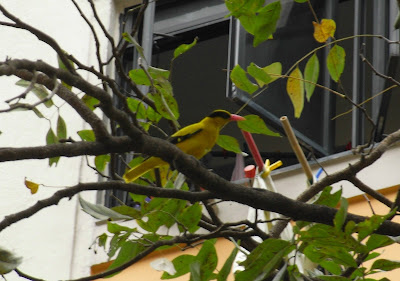 What my family commonly refers to as the yellow bird is actually the Black-naped Oriole (Oriolus chinensis). Many of us probably hear its cry frequently but do not often see it. Glad I walked home that day and decided to look up. This oriole kind of reminds me of a pirate (Zorro, even) because of its black mask.
 This is the Yellow Saraca (Saraca cauliflora aka S. thaipingensis)*. This tree looked as if it was decorated with bouquets of orange-gold from the way its flowers were in bloom. Pretty sight :)
  And just before reaching home, I couldn't resist talking one last photo of this Chiku tree, which is otherwise known as the Sapodilla (Manilkara zapota).
The whole time we were there, the bird flew in and out of this recess, gathering dried leaves to build its nest, presumably. Just found out that this is an Olive-backed Sunbird (Cinnyris jugularis)*. For clearer pictures, do take a look at the Mangoverde World Bird Guide Species Page: Olive-backed Sunbird - http://www.mangoverde.com/birdsound/spec/spec166-94.html. Check out http://rmbr.nus.edu.sg/nis/bulletin2008/2008nis207-210.pdf for interesting information about the display of the male Olive-backed Sunbird and its pectoral tufts. [Edit]
 Front view of a female Olive-backed Sunbird, though somewhat blurry. Males of this species are more brightly-coloured than the females, with metallic blue feathers covering the front of their heads and extending to their breasts. Have a look at a picture of a male here. [Edit]
 I always pass by this canal on my way to school, except this time I was on foot. Was not surprised to see egrets (it seems to be their migratory season now and they're fairly common in Singapore during this time). The bird on the right appears to be a Little Egret (Egretta garzetta). I based the ID on the fact that it has a black beak and slight stature. The Chinese Egret (Egretta eulophotes), a globally-threatened species, also has a blackish beak but it is larger, and is much rarer in Singapore during the migratory season.Pretty flowers by the roadside. Likely that this is Ixora sp., as suggested by Ze Lin.
Yup, it's an Ixora as confirmed by LK*. More precisely, it's an Ixora cultivar (cultivar refers to a variety of a plant that has been created or selected intentionally and maintained through cultivation as stated at Dictionary.com) which has been given the name of Ixora 'Super Pink'. The name says it all. [Edit]
The unopened flower buds of Ixora 'Super Pink'*. [Edit] Can see that it has black specks of dirt on its leaves from all the dust and exhaust from passing vehicles.  Heads up!
 This is probably a Plantain Squirrel (Callosciurus notatus), a common resident of Singapore.
 What my family commonly refers to as the yellow bird is actually the Black-naped Oriole (Oriolus chinensis). Many of us probably hear its cry frequently but do not often see it. Glad I walked home that day and decided to look up. This oriole kind of reminds me of a pirate (Zorro, even) because of its black mask.
 This is the Yellow Saraca (Saraca cauliflora aka S. thaipingensis)*. This tree looked as if it was decorated with bouquets of orange-gold from the way its flowers were in bloom. Pretty sight :)
 Found an interesting article from the Bird Ecology Study Group on the Saraca and Sunbirds.
Read it at http://besgroup.talfrynature.com/2008/01/30/saraca-and-sunbirds/.
Got more excited upon reading the last sentence -"The tree attracts many species of birds that visit for the flower nectar and fruits.". Wow! The tree is within walking distance from my home..*starts thinking of bird-stalking* [Edit]
Read it at http://besgroup.talfrynature.com/2008/01/30/saraca-and-sunbirds/.
Got more excited upon reading the last sentence -"The tree attracts many species of birds that visit for the flower nectar and fruits.". Wow! The tree is within walking distance from my home..*starts thinking of bird-stalking* [Edit]
 And just before reaching home, I couldn't resist talking one last photo of this Chiku tree, which is otherwise known as the Sapodilla (Manilkara zapota).
Acknowledgements:
For this post, much of the info was obtained from Private Lives: An Exposé of Singapore's Mangrove (editors: Peter K. L. Ng, Wang Luan Keng and Kelvin K. P. Lim).
*LK, thanks for pointing out the IDs!
Thoughts:
Ever since construction for a park opposite my block began, the neighbourhood has been filled with more cries of different birds, most notably that of the Asian Koel (Eudynamys scolopacea). This morning, upon the urging of my mother who saw a bird with a large wingspan, I quickly turned to look out the window and was wow-ed by the sight. The bird made one turn and then glided past. It mostly had medium brown plumage from what I could see (only saw its underside). The underside of its wings had a white 'row' of feathers near the top whilst the rest of it was brown with speckles. I'd really like to know what bird it was. Two birds come to mind: the Asian Koel and the sparrowhawk. But it could be neither too. Hmm...
Saturday, January 17, 2009
A Preview of What's to Come...
 Stressed-out Biscuit Sea Star (Goniodiscaster scaber) at Changi Beach
Cries of the Asian Koel
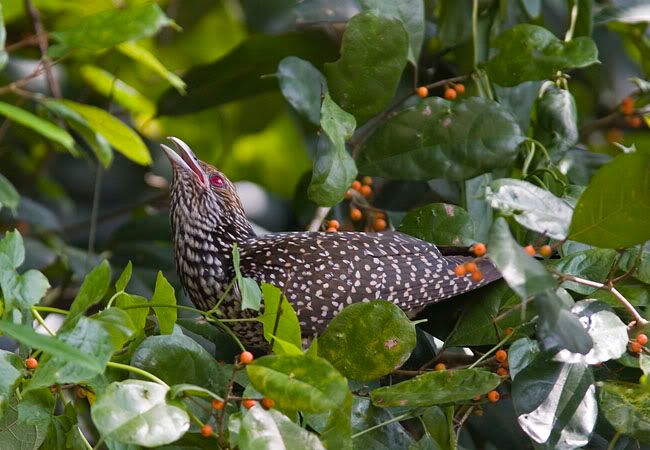 Tube feet, and now a mention of a koel? You probably were expecting to see a post about marine life, but before that, I thought I'd give a short 'welcome' post.
 Living in such an urbanised world, it is easy to relegate nature to the periphery though it is all around us. After all, what one usually sees first are buildings, buildings...and more buildings...especially for those of us who stay in high-rise flats or apartments.
In the morning when I first open my eyes, that's what I see, and a curve of the sky. Doesn't sound too bad, I know. Sometimes though, before wakefulness approaches, I hear the insistent cries of 'ko-el, ko-el, ko-el!' and in that moment, I can imagine that I'm out in the wild. So, Mr, Mrs or Ms Asian Koel (Eudynamys scolopacea), I just want to say thank you to you for being such a great reminder!
Photo taken by arm of ClubSNAP :)
Random: There was once when I was out windsurfing and couldn't get back to shore. Out of the blue, I heard the cries of the Asian Koel and felt encouraged to keep trying and trying. Quite surprised to hear its cry at ECP. In the end, I was towed back to shore by the powerboat though. Haha.
Subscribe to:
Posts (Atom)


_-Singapore_Botanic_Gardens-8.jpg)