In the wee hours of Saturday morning, dozens of Project Semakau volunteers left their homes in order to reach Marina South Pier by 5 am. We were going to the island to conduct the first transect survey.
 It was still dark when we got to the pier and similarly when the ferry reached Semakau.
As transport is not provided at such an early hour, we had to walk to the intertidal zone from the visitor centre. The early morning air was cool and punctuated with bird calls, as our diurnal feathered friends slowly awoke from their slumber.
In no time, we had walked through the secondary forest and reached the intertidal area. At the beginning of the seagrass meadow, we had an encounter with...
 ...an unknown sea hare (Order Anaspidea).
 Wen Qing, Samuel and myself were in seagrass transect team 2. While doing the survey, we saw plenty of seagrass in the 30 m stretch (but not as much as before like during the transect training) and also some interesting things like the mucus coating made possibly by a wrasse (Family Labridae) or some other kind of fish [edit]. One interesting fact about wrasses is that they can change their gender! O.O
 Seagrass is indeed tricky as we soon realised for ourselves...
 1) Thalassia hemprichii.
According to the ID sheet, the leaves have "short, black bars of tannin cells". But as you can see, these bars aren't obvious at all. This is a good example of how things in the field often differ from what is on paper... So how to ID Thalassia? Though their sickle-shaped leaves are a good giveaway, if unsure, it's best to feel for their rhizomes which are scarred and appear reddish-brown :)
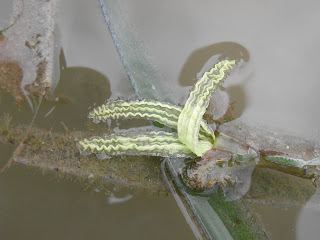
 2) Cymodocea serrulata.
Often confused with Enhalus acoroides and Thalassia hemprichii, this species does have one visible distinguishing feature - a serrated leaf edge! If that does not help, feel for the rhizomes, which are smooth and closer to the surface than Thalassia.
 3) Halodule uninervis.
We didn't think we'd encounter this species, so we had to confirm its ID with Ron. The above is a young specimen. It has a white rhizome with black scars. In mature specimens, a distinctive centre vein is visible, and leaf tips have three distinct points.
 After completing the transect survey, we were given some time to explore. One group followed Ron, while the other followed July. Saw this Sandfish Sea Cucumber (Holothuria scabra) soon after heading out.
 Knobbly no. 1.
 Underside of Knobbly no. 1
 Knobbly no. 2. One of its arms is slightly shorter than the rest which could be a result of an injury and subsequent regeneration.
 Knobbly no. 3.
 Underside of Knobbly no. 3, with focus on its mouth (centre) and the ambulacaral areas which house its tube feet.
 Knobblies no. 4 and 5. The Knobbly on the left looks really 'juvenile' (but that's just my opinion).
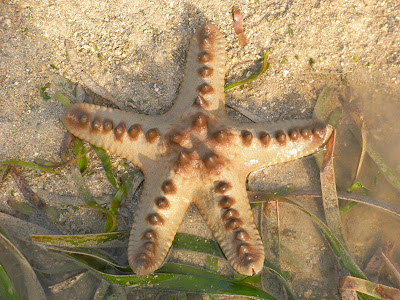 Knobbly no. 6. With two of its arms closer than normal to each other, this sea star here looks like it's getting ready to dance.
 Growing in bunches were some green algae (Caulerpa sp.).
 This is a first for me! In one of the tidal pools, this Heart Cockle (Corculum cardissa) was clearly visible in the shallow and clear water. When it dies, the heart breaks...
 An Orange-edged Black Flatworm (probably Pseudobiceros uniarborensis). Another 'first' for me on Semakau.
 Looking like a protrusion from the substrate was this Common Hairy Crab (Pilumnus vespertilio). The hairs on its body trap sediment which, over time, allows it to look like a piece of the substrate itself.
 A view of the coral rubble area.
 Growing in between this magnificent Staghorn Acropora Coral (Acropora sp.) was a fan shell (Family Pinnidae).
 Hmm..egg cases of a mollusc? It's likely an egg ribbon of a nudibranch or some other species of slug.*
 This sea cucumber (Actinopyga sp.) is thought to be a juvenile Stonefish Sea Cucumber due to similar physical traits, but that is based on speculation and not yet confirmed*.
 This is by far the smallest Noble Volute (Cymbiola nobilis) that I have seen. Is it a juvenile? From its shell alone, I wouldn't have been able to ID it as the typically associated 'mountain ranges' pattern is absent. Lucky its black with orange spots muscular foot was showing.
 Saw a lot of these Common Sea Stars aka Sand-sifting Sea Star (Archaster typicus). Here is a pair getting ready to mate with the male on top (such pairing behaviour is known as pseudocopulation) [edit]. Like other sea stars, external fertilisation takes place (meaning reproductive organs don't actually meet).
 2) Cymodocea serrulata.
Often confused with Enhalus acoroides and Thalassia hemprichii, this species does have one visible distinguishing feature - a serrated leaf edge! If that does not help, feel for the rhizomes, which are smooth and closer to the surface than Thalassia.
 3) Halodule uninervis.
We didn't think we'd encounter this species, so we had to confirm its ID with Ron. The above is a young specimen. It has a white rhizome with black scars. In mature specimens, a distinctive centre vein is visible, and leaf tips have three distinct points.
Mostly, there was a lot of Tape Seagrass (Enhalus acoroides), noticeable numbers of Syringodium isoetifolium (Noodle Seagrass), some Cymodocea serrulata (Serrated Ribbon Seagrass), a little of Halophila ovalis/minor (Spoon Seagrass), even less of Thalassia hemprichii (Sickle Seagrass) and only one quadrat with Halodule uninervis (Needle Seagrass). For more info, visit the I.D. Seagrass page of the Seagrass-Watch website :)
 After completing the transect survey, we were given some time to explore. One group followed Ron, while the other followed July. Saw this Sandfish Sea Cucumber (Holothuria scabra) soon after heading out.
There were numerous juvenile Knobbly Sea Stars (Protoreaster nodosus) out that day! Yay! They really come in a myriad of colours. As echinoderms have a water vascular system, they will get stressed and die if left out of water for too long. That's why we always replace them after a quick photo.
 Knobbly no. 1.
 Underside of Knobbly no. 1
 Knobbly no. 2. One of its arms is slightly shorter than the rest which could be a result of an injury and subsequent regeneration.
 Knobbly no. 3.
 Underside of Knobbly no. 3, with focus on its mouth (centre) and the ambulacaral areas which house its tube feet.
 Knobblies no. 4 and 5. The Knobbly on the left looks really 'juvenile' (but that's just my opinion).
 Knobbly no. 6. With two of its arms closer than normal to each other, this sea star here looks like it's getting ready to dance.
Saw a few more Knobblies, but didn't upload all the pics here.
 Growing in bunches were some green algae (Caulerpa sp.).
 This is a first for me! In one of the tidal pools, this Heart Cockle (Corculum cardissa) was clearly visible in the shallow and clear water. When it dies, the heart breaks...
 An Orange-edged Black Flatworm (probably Pseudobiceros uniarborensis). Another 'first' for me on Semakau.
 Looking like a protrusion from the substrate was this Common Hairy Crab (Pilumnus vespertilio). The hairs on its body trap sediment which, over time, allows it to look like a piece of the substrate itself.
 A view of the coral rubble area.
 Growing in between this magnificent Staghorn Acropora Coral (Acropora sp.) was a fan shell (Family Pinnidae).
 Hmm..egg cases of a mollusc? It's likely an egg ribbon of a nudibranch or some other species of slug.*
 This sea cucumber (Actinopyga sp.) is thought to be a juvenile Stonefish Sea Cucumber due to similar physical traits, but that is based on speculation and not yet confirmed*.
 This is by far the smallest Noble Volute (Cymbiola nobilis) that I have seen. Is it a juvenile? From its shell alone, I wouldn't have been able to ID it as the typically associated 'mountain ranges' pattern is absent. Lucky its black with orange spots muscular foot was showing.
 Saw a lot of these Common Sea Stars aka Sand-sifting Sea Star (Archaster typicus). Here is a pair getting ready to mate with the male on top (such pairing behaviour is known as pseudocopulation) [edit]. Like other sea stars, external fertilisation takes place (meaning reproductive organs don't actually meet).
References:
Wild Fact Sheets of marine life on Singapore shores - http://www.wildsingapore.com/wildfacts/
Acknowledgements:
[edit], *Thanks to Ron for the corrections and IDs!


 Bakaus (Rhizophora spp.) greet visitors to the Semakau intertidal area. Learned that 2 species can be found growing on the edges of the sandy shore - R. apiculata and R. stylosa.
 Though both species look similar, they can be told apart even at a distance by their roots. Both mangroves have stilt or prop roots, but those of R. apiculata are not so spread out as compared to that of R. stylosa. In addition, the stipule
 Here are the tools of the 'trade' (clockwise from left): ruler, transect tape, clipboard with recording sheet, ID chart and quadrat. We grouped ourselves into team of threes. Gerald, Samuel and I worked together :)
 At the perimeter of the seagrass meadow, Gerald sighted a Blue-spotted Fantail Ray (Taeniura lymma) hiding among the seagrass.
 Among the seagrass, there were many small bunches of this red algae (Gracilaria sp.).
  Drifting lazily on the surface of the water and blown about by gusts of wind were the tiny white male flowers of the Tape Seagrass (Enhalus acoroides).
 Blue corals (Heliopora coerulea) in the seagrass meadow! Note that these may appear to be hard corals, but they are actually soft corals.
  Woohoo! My first time seeing a Knobbly Sea Star (Protoreaster Nodosus) on Semakau.
 If quickly flipped over, one will be able to see its tube feet waving about as well as the protruding muscle-like mass which is its stomach.
 This pic looks familiar, right?
  Check out the intricate detail on the Knobbly's body. Simply amazing.
 This tentacle-waving anemone (probably a Wiggly Star Anemone) is very shy indeed. It quickly retracted its tentacles and ducked away (methinks it is motile) when I approached it. Had to wait for a little while before it felt comfortable enough to venture out again.
 Some more anemones nearby. These had bright greenish-yellow tentacles, and were about 1-2 cm in diameter. I've no clue as to what kind of species they might be.
  The first time I saw a cowrie was on Sultan Shoal. This appears to be an

 This fish (a scorpionfish, maybe?) announced its presence by thrashing about wildly in the sargassum it was taking shelter in.
  Ying Wei spotted this rare find: a Heart Urchin!
 The cacophony coming from the direction of the sandy shore alerted me to the presence of these two birds, Great-billed Herons (Ardea sumatrana) probably . They were making barking/honking noises and one could have easily mistaken them for some other kind of animal!
  And what better way to wrap up the day by having another sea star sighting? July chanced upon this Cryptic Star (Cryptasterina sp.) which was hiding under a rock.